Scales of Time
The Victorians weren’t obsessed with death. They were afraid of forgetting. There is a difference and it matters.

Welcome to Death Masks of the 21st Century, a series exploring the crossing between what is fleeting and what is permanent. The weight of a life, the impressions we leave when biology insists on making it temporary, and the radical act of refusing to let a life simply dissolve.
I think a lot about the women I will never meet. All my grandmothers, whoever they were, whenever they were. If I could gather them in some weird room of the undead, admission documented in our DNA and lost to statistics every two hundred years or so. At least that’s what we think we understand about the whole Adenine (A) Thymine (T) Guanine (G) Cytosine (C) of it all. And before that, one of their mothers wasn’t quite human. And before that?
I just love the scales of time.
If I look a generation or two back, I might have photographs of a few of these women. Before that, they are names in a record book.
I look for them in the mirror, but that information is only skin deep.
Which is why I keep returning to the Victorian death mask, a literal Memento Mori. Plaster castings of the faces of their dead. Can you imagine a quick DIY in the hours after death, before the features settled into something unrecognizable. We call this morbid today but it’s easy to see how this practice was actually very sweet. Very loving. Extremely human. And not all that different from what we do today.
Before photographs, a face disappeared the moment it was buried. Not gradually. Immediately. The exact proportion of a nose, the specific way a mouth rested at peace, the particular geography of a face you had looked at your entire life: gone. Surviving only in human memory. Which, as anyone who has tried to hold a face knows, is not enough.
Here is something we have always understood about ourselves, even before the science confirmed it: memory is not a recording. It is a reconstruction. Every time we access it we are rebuilding from fragments, and every rebuilding changes it slightly. We forget faces within weeks. We confuse details within days. The Victorians didn’t need a neuroscience to explain, they just knew from experience that the face was going.
The death mask wasn’t theater. It was a daughter who wasn’t ready. A husband, a son, someone with plaster and a few hours and nothing else. No handhold. Just grief, raw and new, and a desperate wanting to keep something of what they knew they were already losing.
What I find beautiful about it, and I do find it beautiful, is the honesty. No flattering angles. No softened light. Just the unfiltered truth of someone’s face at the moment they finished being alive. The swelling. The slack. The realness of a body that had just done the this it does. The Victorians weren’t obsessed with death. They were afraid of forgetting. There is a difference and it matters.
They kept these objects in the front room. Not in a cabinet, not in a box. On the mantel, where the family gathered. The person remained, in some sense, part of the daily life of the house. We find this strange now. We have moved death to a professional industry that happens elsewhere, managed by people we hire precisely so we don’t have to be present for it. We have made forgetting easier and called it progress.
I’m not sure it was.
What I notice in my own work, sitting with families at this threshold, being present for what most people now outsource, is that the impulse hasn’t changed at all. The death mask is a memory foam mattress. A screensaver set to a photograph. A voice message kept in a phone for years after the person is gone because deleting it feels like something final that the death itself somehow wasn’t. Different century, same love with nowhere to go.
We are still making death masks. We just use different materials. But I keep thinking about a women still who had none of these materials.
I don’t have their names. I find her in the image of someone crushing grain, making something edible from what the land offered, feeding her children with the slow patient work of survival. And she too was a girl before she became a mother. Walking among trees so large they had no human scale. Old growth cedar and fir standing for a thousand years before she arrived, standing for a thousand years after. The kind of forest that holds water in its canopy, mists the air, houses entire worlds in its upper branches and entire conversations in its roots.
She was probably very young. Probably tired. Probably trying to remember her own mother’s face with no plaster, no photograph, no record book. Maybe a rock carving. Maybe nothing.
What it must have meant to walk among those giants! To be small in that particular way. Not diminishing… clarifying. The trees didn’t care about the cycle of maiden, mother, elder that was making her life harder every year. To the trees she was still that girl. She always would be.
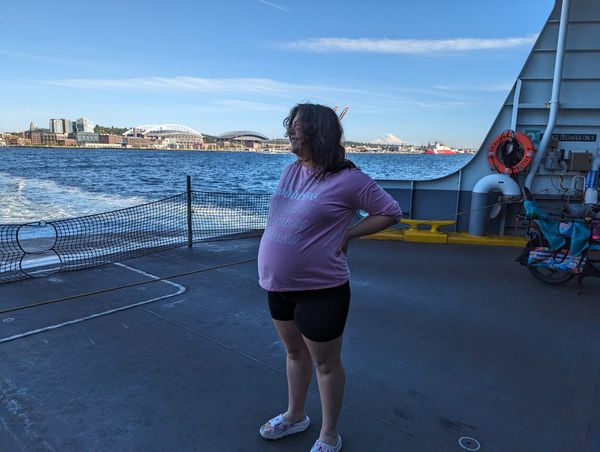
Bainbridge Island was no doubt that kind of forest once. The honorable Suquamish people lived among old growth cedar and fir for thousands of years before the logging came in. And, of course, by early 1900s most of it was gone. What stands today can only be a few hundred years old at most, beautiful, alive, real, but not what she walked through. I can’t walk among what she walked among. I can only imagine it from the edge of what grew back.
Outside my window there are pine trees a few hundred years old. They move with the wind in a way that looks like thinking. An eagle family roosts up there, has for years, or maybe it’s a different eagle each year returning to the same place. I’m still trying to work that out. The trees here houses an entire ecosystem I can’t fully see. It is not the forest she knew at all. But something of that forest is in it. The roots go deeper than the logging did. The woman crushing grain maybe a thousand years ago, my grandmother ten thousand times removed, she is not lost. She is only out of scale and sight.
Next week: More trees. The stumps that are still feeding and what the forest knows about memory that we keep having to relearn.